Visualizzazione post con etichetta NASA. Mostra tutti i post

martedì 13 dicembre 2011

Spiral Galaxy NGC 2841 Close Up

sabato, 19 febbraio 2011

Spiral Galaxy NGC 2841 Close Up

Bellezza che conforta
Centro splendente che attrae
I colori dell'infinita armonia delle sfere celesti
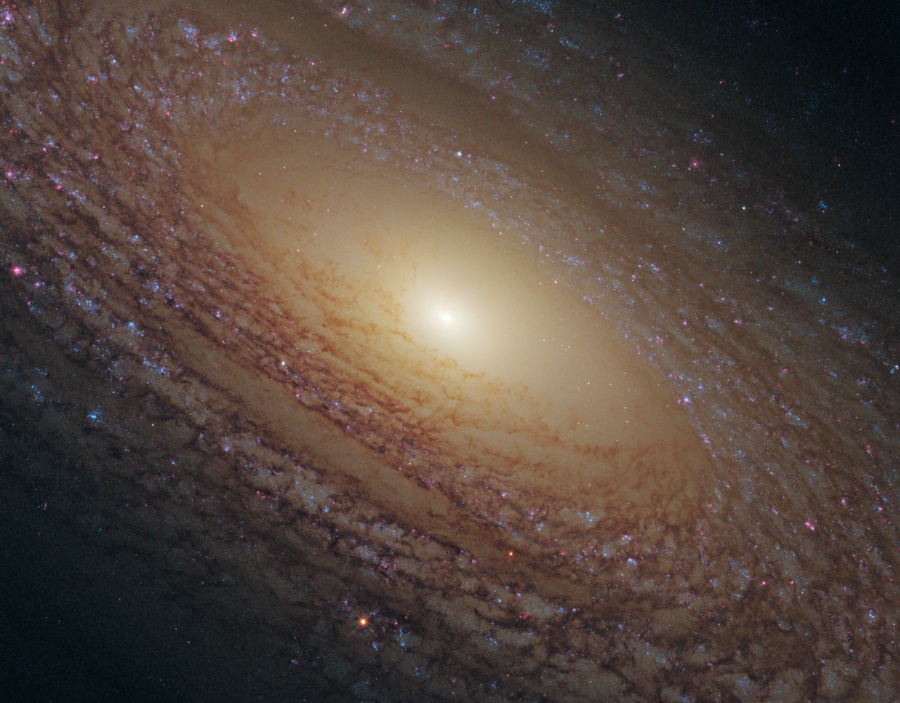


Credit: NASA, ESA, and the Hubble Heritage (STScI / AURA) - ESA / Hubble Collaboration
 
Explanation: A mere 46 million light-years distant, spiral galaxy NGC 2841 can be found in the northern constellation of Ursa Major. This sharp view of the gorgeous island universe shows off a striking yellow nucleus and galactic disk. Dust lanes, small, pink star-forming regions, and young blue star clusters are embedded in the patchy, tightly wound spiral arms. In contrast, many other spirals exhibit grand, sweeping arms with large star-forming regions. NGC 2841 has a diameter of over 150,000 light-years, even larger than our own Milky Way, but this close-up Hubble image spans about 34,000 light-years along the galaxy's inner region. X-ray images suggest that resulting winds and stellar explosions create plumes of hot gas extending into a halo around NGC 2841.

 
February 17, 2011: NASA's Hubble Space Telescope reveals a majestic disk of stars and dust lanes in this view of the spiral galaxy NGC 2841, which lies 46 million light-years away in the constellation of Ursa Major (The Great Bear). This image was taken in 2010 through four different filters on Hubble's Wide Field Camera 3. Wavelengths range from ultraviolet light through visible light to near-infrared light.

SQUARCI Rifts

giovedì, 03 febbraio 2011

SQUARCI 4
Rifts


uno squarcio che rivela meravigliosi azzurri stellari

*

 
Hidden Treasures of M78
Credit: ESO / Igor Chekalin
Explanation: M78 isn't really hiding in planet Earth's night sky. About 1,600 light-years away and nestled in the nebula rich constellation Orion, the large, bright, reflection nebula is well-known to telescopic skygazers. But this gorgeous image of M78 was selected as the winner of the Hidden Treasures 2010 astrophotography competition. Held by the European Southern Observatory (ESO), the competition challenged amateur astronomers to process data from ESO's astronomical archive in search of cosmic gems. The winning entry shows off amazing details within bluish M78 (center) embraced in dark, dusty clouds, along with a smaller reflection nebula in the region, NGC 2071 (top). Yellowish and even more compact, the recently discovered, variable McNeil's Nebula is prominent in the scene below and right of center. Based on data from ESO's WFI camera and 2.2 meter telescope at La Silla, Chile, this image spans just over 0.5 degrees on the sky. That corresponds to 15 light-years at the estimated distance of M78.

Iris di stelle

giovedì, 20 gennaio 2011

Iris di stelle
per dolcetta 


See Explanation.  Clicking on the picture will download the highest resolution version available.


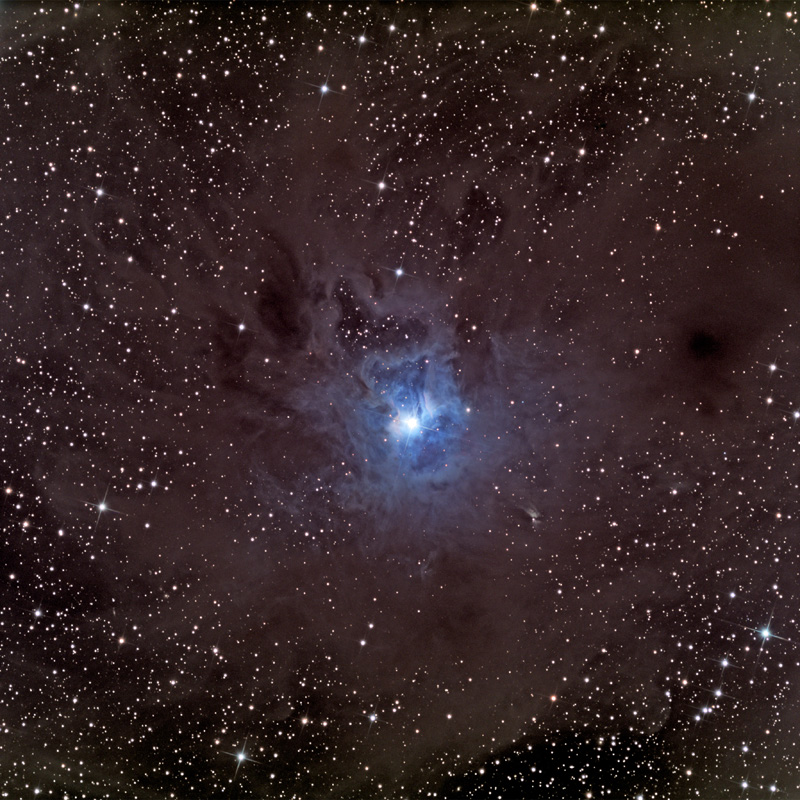
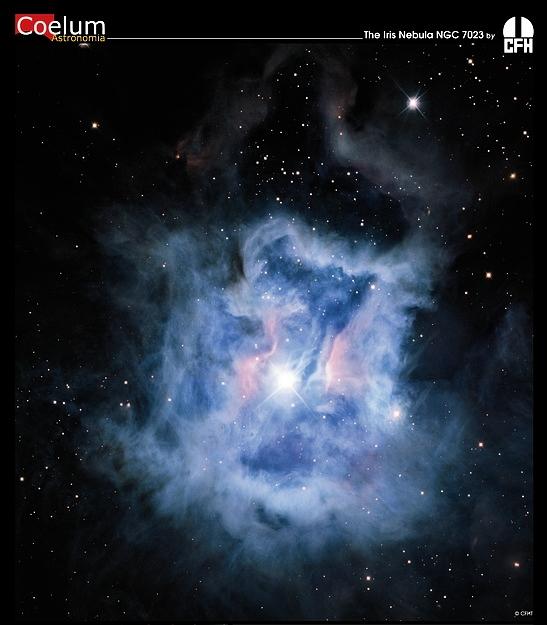
NGC 7023: The Iris Nebula 

 
 Like delicate cosmic petals, these clouds of interstellar dust and gas have blossomed 1,300 light-years away in the fertile star fields of the constellation Cepheus. Sometimes called the Iris Nebula and dutifully cataloged as NGC 7023, this is not the only nebula in the sky to evoke the imagery of flowers. Still, this beautiful digital image shows off the Iris Nebula's range of colors and symmetries in impressive detail. Within the Iris, dusty nebular material surrounds a hot, young star. The dominant color of the brighter reflection nebula is blue, characteristic of dust grains reflecting starlight. Central filaments of the dusty clouds glow with a faint reddish photoluminesence as some dust grains effectively convert the star's invisible ultraviolet radiation to visible red light. Infrared observations indicate that this nebula may contain complex carbon molecules known as PAHs. As shown here, the bright blue portion of the Iris Nebula is about six light-years across.

 2011 January 20
See Explanation.  Clicking on the picture will downloadthe highest resolution version available.
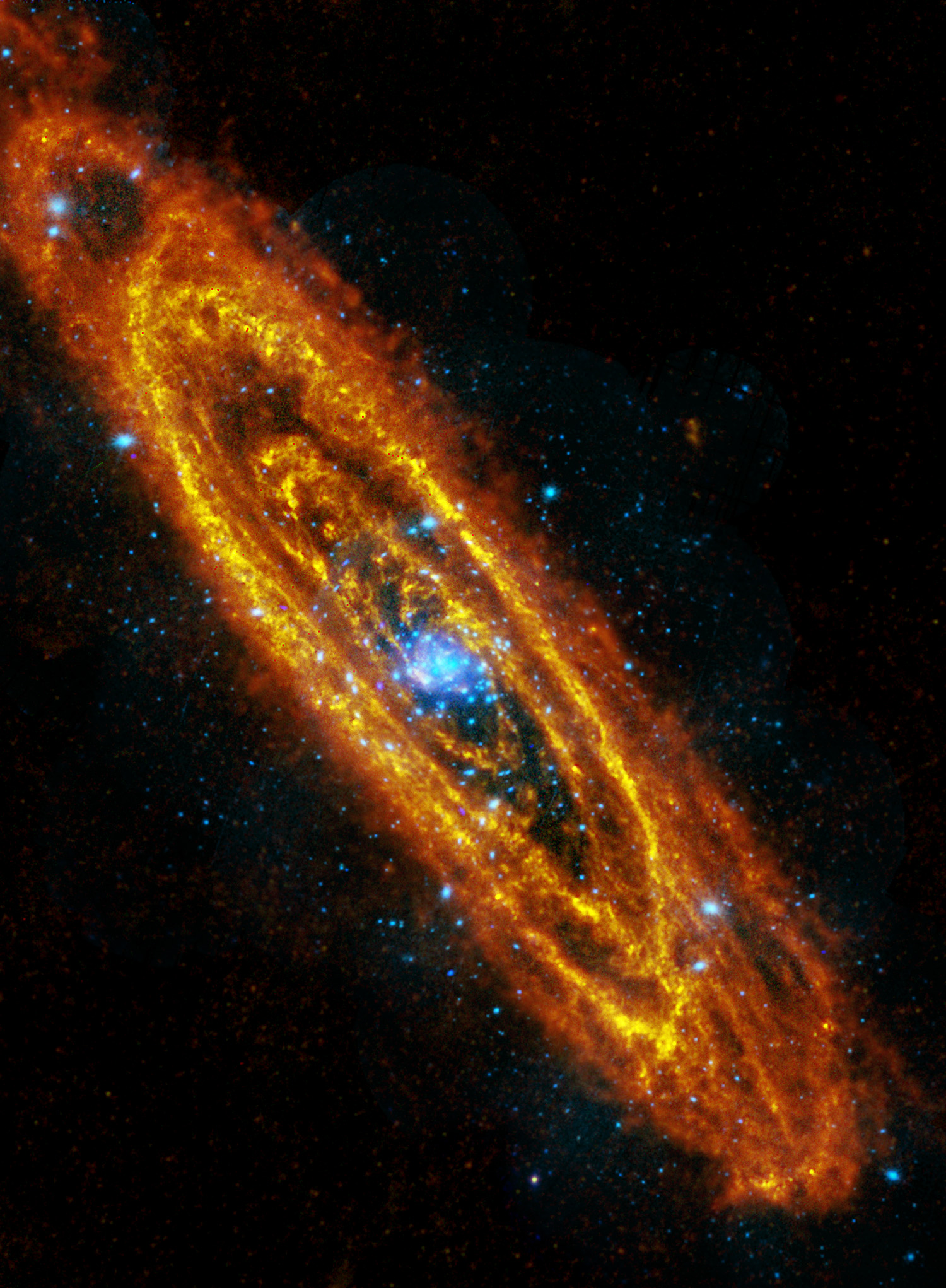
The Once and Future Stars of Andromeda
Credit and Copyright: ESA/Herschel/ PACS/SPIRE/J.Fritz(U.Gent) / XMM-Newton/EPIC/W.Pietsch(MPE)
Explanation: The big, beautiful Andromeda Galaxy, aka M31, is a spiral galaxy a mere 2.5 million light-years away. Two space-based observatories have combined to produce this intriguing composite image of Andromeda, at wavelengths outside the visible spectrum. The remarkable view follows the locations of this galaxy's once and future stars. In reddish hues, image data from the large Herschel infrared observatory traces enormous lanes of dust, warmed by stars, sweeping along Andromeda's spiral arms. The dust, in conjunction with the galaxy's interstellar gas, comprises the raw material for future star formation. X-ray data from the XMM-Newton observatory in blue pinpoint Andromeda's X-ray binary star systems. These systems likely contain neutron stars or stellar mass black holes that represent final stages in stellar evolution. More than twice the size of our own Milky Way, the Andromeda Galaxy is over 200,000 light-years across.

domenica 11 dicembre 2011

mercoledì 7 dicembre 2011

Cielo Stellato e Terra

mercoledì, 28 febbraio 2007

Cielo Stellato e Terra


See Explanation.  Clicking on the picture will download 
 the highest resolution version available.

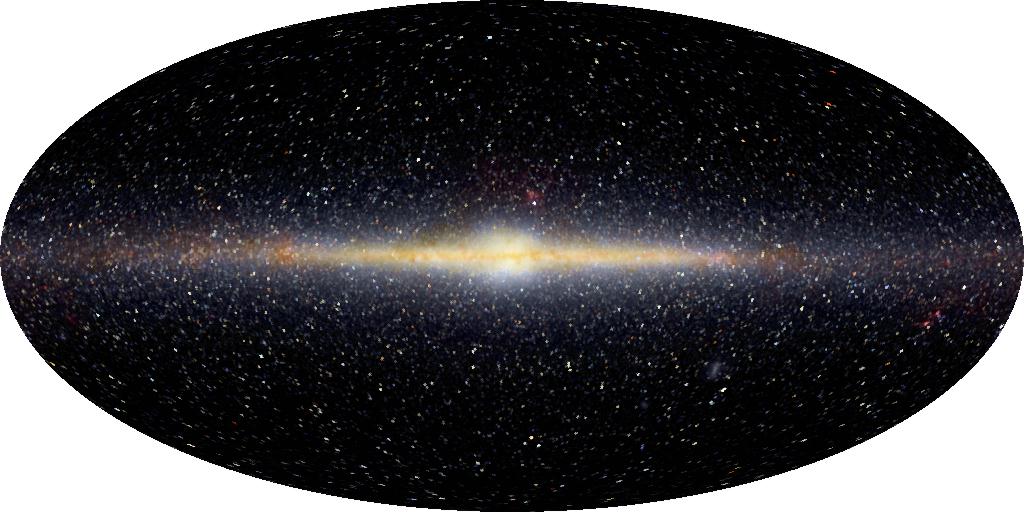
The Milky Way in Infrared
Credit:
The COBE Project, DIRBE, NASA


Molte volte ho guardato la Via Lattea nelle notti serene e limpide, nelle campagne estive,  sulle montagne invernali, nei deserti aridi e sconfinati, dove fortissima è la sensazione di poterle toccare le stelle solo allungando il braccio. Non ho mai visto, però, l'abbraccio drammatico tra la nostra Galassia e noi, anche se avviene due volte al giorno.
Sotto la volta di un Universo sconosciuto di creazione e distruzione mi sento atomo insignificante di pulviscolo stellare e invincibile scintilla di un'unica essenza. A un tempo. In un incredulo stupore e in una tensione incessante. Tra l'isolamento sterile nella mia realtà individuale e la ricerca dell'identificazione con l'Unità, non-duale e senza forma, di cui hanno parlato i rishi, gli antichi saggi dell'induismo, e il Buddha, tutti i Buddha.
E' consolante la visione dell'unità cosmica, vibrazione totale, in cui ogni dualistica contrapposizione è solo apparenza illusoria. Ma io la contemplo senza potervi accedere,  straniata, per quanto potentemente attratta e affascinata.


Explanation: At night, from a dark location, part of the clear sky looks milky. This unusual swath of dim light is generally visible during any month and from any location. Until the invention of the telescope, nobody really knew what the "Milky Way" was. About 300 years ago telescopes caused a startling revelation: the Milky Way was made of stars. Only 70 years ago, more powerful telescopes brought the further revelation that the Milky Way is only one galaxy among many. Now telescopes in space allow yet deeper understanding. The above picture was taken by the COBE satellite and shows the plane of our Galaxy in infrared light. The thin disk of our home spiral galaxy is clearly apparent, with stars appearing white and interstellar dust appearing red.

martedì 6 dicembre 2011

ALBORZ


domenica, 04 febbraio 2007


ALBORZ


I monti Alborz hanno accompagnato alcuni anni della mia vita a Tehran. Immensi, le cime altissime perennemente innevate, onnipresenti lungo tutto l'orizzonte settentrionale della città, e misteriosi per i richiami che mi sembrava mandassero alla mia mente. Sentivo in maniera del tutto infantile che fra quelle rocce straordinarie si nascondeva un segreto che mi sarebbe stato rivelato se solo avessi saputo concentrarmi e ascoltare chissà quale voce lontana. Fantasie. Fantasie che la fotografia del giorno di ieri nel sito della Nasa ha fatto riemergere intatte e suggestive più che mai. Fantasie rafforzate da un link a un sito di fotografie che restituiscono alcune favolose immagini dell'Iran. Come non riandare con tutta l'anima al sublime Rumi e alla sua mistica Luna?


 LA LUNA


Nel firmamento è apparsa all'alba una Luna
è scesa dal cielo e ha rivolto a me lo sguardo.
Come falco che strappa via un uccello qual preda
mi rapì quella Luna e corse di nuovo nel cielo.
E quando me stesso guardai, più me stesso non vidi;
ché, in quella Luna, il mio Corpo per grazia sottile s'era fatto anima pura!
E quando viaggiai entro l'anima non vidi che Luna
finché svelato fu tutto della manifestazione eterna il mistero!
I nove cerchi del cielo s'erano immersi in quella luna,
e la barca dell'essere mio s'era tutta in quel mare nascosta.
Si franse d'onde quel mare, e tornò la Ragione
e lanciò il suo grido: così fu, così avvenne.
Spumeggiò, quel mare; e da ogni frammento di quella schiuma
di qualcuno venne un disegno, venne di qualcosa  un corpo,
e ogni frammento di schiuma corporea che si mostrò da quel mare
poi subito si fuse e in quel mare entrò ancora;
ma senza l'aiuto del Signore, del Sole divino di Tabrìz
non si può vedere la Luna, non si può essere mare.

Rumi

ANALEMMA

sabato, 23 dicembre 2006

ANALEMMA


2006 December 23

 
See Explanation.  Clicking on the picture will download
the highest resolution version available.

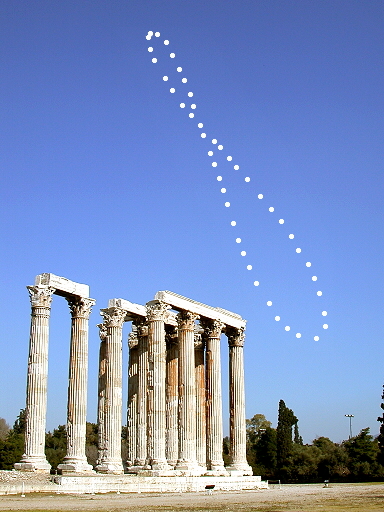
The Analemma and the Temple of Olympian Zeus
Credit & Copyright: Anthony Ayiomamitis
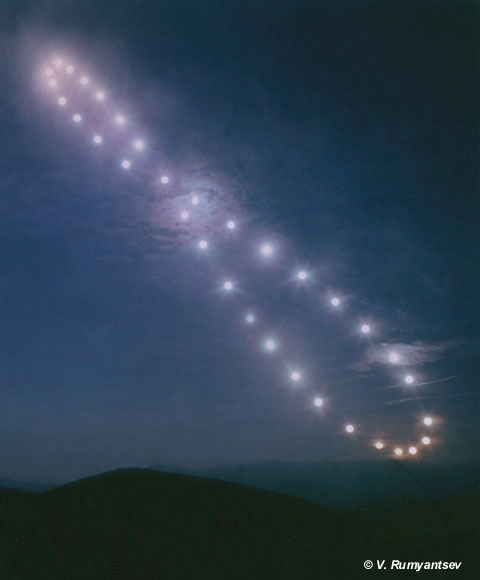
Explanation: An analemma is that figure-8 curve you get when you mark the position of the Sun at the same time each day throughout planet Earth's year. Above, 47 separate exposures (plus one foreground exposure) were recorded on a single piece of film to illustrate this annual cycle of solar motion from March 30, 2003 to March 30, 2004. In the remarkable foreground are standing Corinthian columns of the ancient Temple of Olympian Zeus in Athens, Greece. Solstices, like the one that occurred at 0022 UT on December 22, correspond to the bottom of the figure-8 or the southernmost excursion of the Sun in the sky. The tilt of planet Earth's axis and the variation in speed as it moves around its orbit combine to produce the graceful analemma curve.
Ho copiato pari pari questa meraviglia dal sito della NASA che visito ogni mattina immancabilmente. (http://antwrp.gsfc.nasa.gov/apod/archivepix.html). La fotografia l'ho vista più volte, ma oggi è stata ugulamente una bella sorpresa. Il solstizio e l'inverno mi spingono a guardare più intensamente il cielo, o meglio, a pensarlo, perché in città ormai le stelle sono ormai invisibili.
Sempre dal prezioso sito della Nasa(http://antwrp.gsfc.nasa.gov/apod/ap020709.html) un altro analemma, molto natalizio questo. E una poesia da recitare.
See Explanation.  Clicking on the picture will download
the highest resolution version available.
Primavera d’inverno: è quella vera,
senza pennacchi verdi, senza fiori.
È ancora puro spirito, è presagio,
misteriosa promessa.

Quando l’aprile esploderà, chiassosa
Scenografia di tinte e profumi,
quella ricorderai, che nell’estrema
neve per te rideva.

Maria Luisa Spaziani
Una poesia offerta da Blue (http://timelineofblue.splinder.com/)


domenica 4 dicembre 2011

Luna e Pleiadi

giovedì, 29 giugno 2006


La Luna crescente con le Pleiadi nel cielo di Giugno
 
 
Matsuo Bashō
 
 
Miru tokoro hana ni arazu to iu koto nashi,
omou tokoro tsuki ni arazu to iu koto nashi

Non c'è nulla che puoi vedere che non sia un fiore. Non c'è nulla che puoi pensare che non sia la luna.

Foto: NASA

sabato 3 dicembre 2011

Per il compleanno di dolcetta

venerdì, 20 gennaio 2006

LL ORI and the ORION NEBULA


2006 January 20


This esthetic close-up of cosmic clouds and stellar winds features LL Orionis, interacting with the Orion Nebula flow. Adrift in Orion's stellar nursery and still in its formative years, variable star LL Orionis produces a wind more energetic than the wind from our own middle-aged Sun. As the fast stellar wind runs into slow moving gas a shock front is formed, analogous to the bow wave of a boat moving through water or a plane traveling at supersonic speed. The small, arcing, graceful structure just above and left of center is LL Ori's cosmic bow shock, measuring about half a light-year across. The slower gas is flowing away from the Orion Nebula's hot central star cluster, the Trapezium, located off the upper left corner of the picture. In three dimensions, LL Ori's wrap-around shock front is shaped like a bowl that appears brightest when viewed along the "bottom" edge. The beautiful picture is part of a large mosaic view of the complex stellar nursery in Orion, filled with a myriad of fluid shapes associated with star formation.

Il trionfo della vita in una stella che nasce dalle nubi cosmiche e dai venti astrali. S'affretta la giovane stella e appare veloce, un palpitante fluido dolce splendore. Musica soave di forme fluttuanti risuona nel cielo quando emerge la stella bambina sollevando amorose correnti di energia e di bellezza.


ORION NEBULA 


 .
A "dolcetta", mia figlia, auguri per il suo compleanno.
 .
Immagini: 1. LL Ori and the Orion Nebula - Credit: NASA, ESA, and The Hubble Heritage Team; 2. Orion Nebula: The Hubble View - Credit: NASA, ESA, M. Robberto (STScI/ESA) and The Hubble Space Telescope Orion Treasury Project Team - 2006 January 19